Product
6 minute read
Somewhere out there, someone has your face
There is a person alive right now who carries your face, and most likely neither of you will ever know it. That is the reason I am building Twynsa, and why it works differently from every other social app.
CR
Chiatiah Rayan
rayanstudio
On this page6 sections
The stranger you will never meet
It has probably happened to you. Someone stops you in a town you have never lived in and calls you by a name that is not yours. A friend sends a photo of a stranger and says this is you, look, this is actually you. You look at it for longer than you meant to.
Then you scroll on, and you never find out who that person was.
There is someone alive right now who carries your face. Not your twin, but close enough that a stranger would stop them the way that stranger stopped you. They might be one town over. They might be on another continent, speaking a language you have never heard, living a life you would not recognise, wearing your mouth and your eyes while they do it. Most likely the two of you will live your whole lives and leave this earth without either of you ever knowing the other one was here.
For all of history there was nothing anyone could do about that. You cannot search a street for a face.
The internet was supposed to be good at this
We put most of the planet online and built networks to connect them. None of those networks can answer the simplest question you can ask about a human body. Who looks like me?
You can search a name, a school, a job title, a hashtag. You can find the people you already know and the people who are already famous. You cannot look for a face, because every platform is built on what you type rather than on what you are. Reverse image search gets closest and still misses. It finds other copies of your photo, not another person.
So the networks sort us by what we perform instead. You pick a handle, write a bio, post, and wait for a number to grow before anything happens to you. What you see is ordered by what keeps you there. It works, if the goal is holding attention. It just never introduces you to anyone you did not already have a reason to know.
Starting from the face you were born with
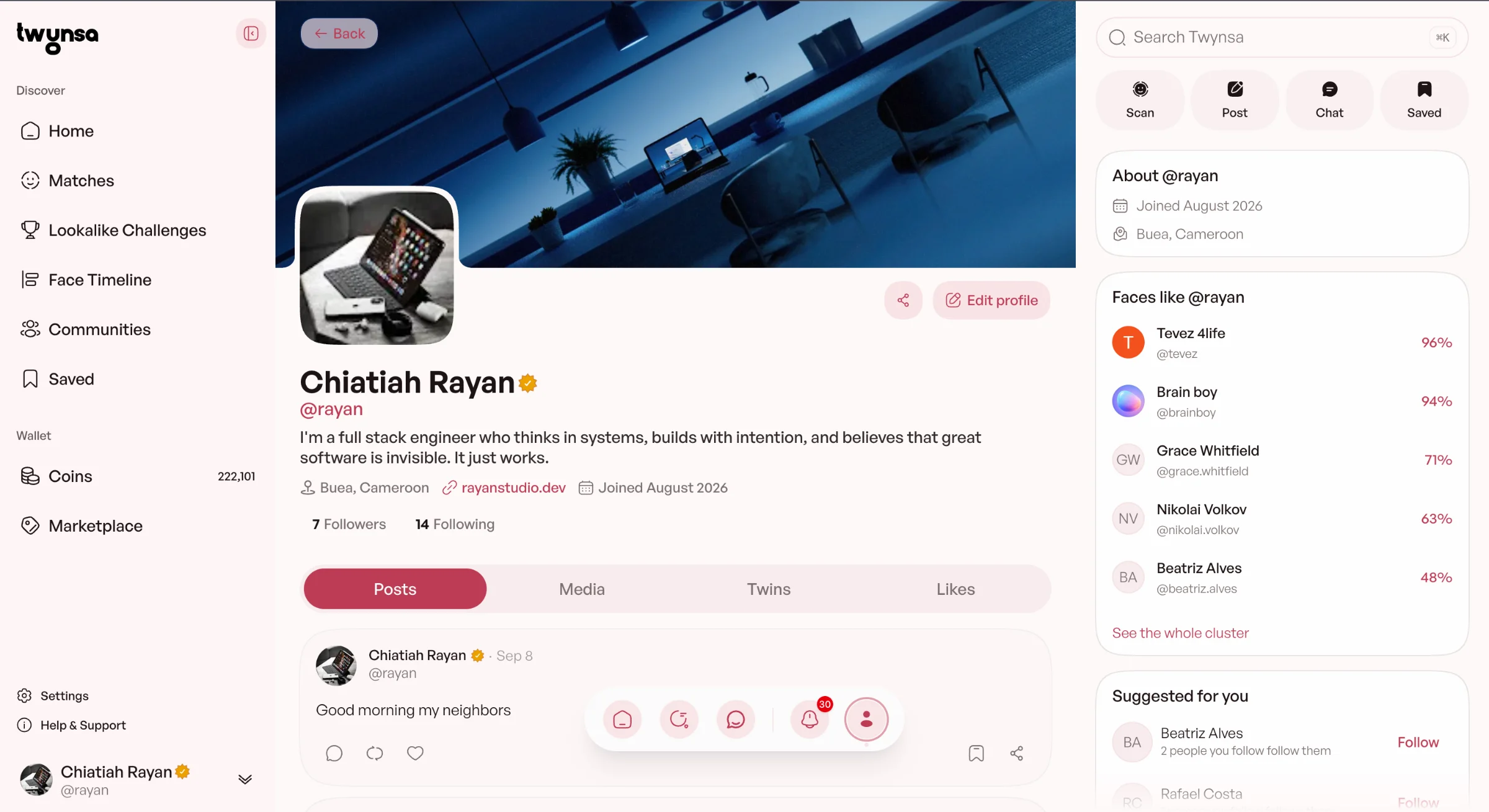
Twynsa starts at the other end. You scan your face, and the first thing the app gives you is people. Not an empty profile to decorate. People, in order, with a number on each one saying how much of your face they share.
The scan is the sign-up. It asks for five angles, straight ahead, left, right, up and down, because one selfie is too easy to fool. Light, angle and expression change a photo more than a face does. Five frames take the guesswork out, and the camera waits until your head is where it asked before it takes each one.
What comes back is a ranked list of strangers. You set how close a face has to be before it reaches you, and how far out the search reaches, from your region to the whole world. Open a profile. Follow. Send a message, which you can do on any plan, to anyone, without waiting for permission from a feed. Some of them will be a loose resemblance you smile at once. One of them, one day, will stop you cold.
Around that there is the rest of it. Rooms built around a look or a city. Challenges where people compete on who matches a prompt best. Posts, calls, and a face timeline that lines up every scan you have run so you can watch your own face change over the years.
Why this is not another social app
Every other network asks you to build an identity before it will show you anybody. Twynsa starts with the one you were born with. Nobody writes a bio to get in, and nobody has to be interesting enough to be shown.
The order of your matches is resemblance, measured. It is not engagement, not a guess about what will keep you scrolling, not an auction. A face is either close to yours or it is not, and the number on the match is the same number you can check on the person looking back at you.
It also points outward. Every feed you use converges on the people you already know, because that is what it has to work with. Twynsa only works if it hands you strangers, so that is what it does.
And it is not dating. A match says nothing about attraction. It says a genetic coincidence put two faces in the same shape and neither of you was ever going to find out on your own. What you do with that is curiosity, which is a better reason to open a conversation than most.
The part I had to get right before anything else
An app built on faces has to answer the obvious question before it asks you for anything, so here it is. Your scan is yours. You consent to it at the scan itself, not buried in the terms. Nobody sees your frames unless you choose to post one. You decide how long they are kept. Deleting your scan stops matching straight away and erases what was behind it, and your face is never used to identify you anywhere outside the app.
I spent more time teaching it when to refuse a scan than when to accept one. Too dark, too far away, eyes closed, a photo of a screen, five frames that turn out to be five different people. All of it gets turned away, and you are told what to fix rather than being shown "scan failed" and left to guess. A product that gets faces wrong does not just annoy people. It matches the wrong stranger to the wrong stranger, and I would rather it said no.
Where it is now
I am building Twynsa on my own, from Buea. The app, the servers behind it, the face matching, the admin tools, the site. The web version is finished as an MVP, the marketing site is live, and the phone app is next.
There are days when it is 29 moving parts and a list of bugs, and I forget what it is for. Then I picture the thing I started with, which is two people in different countries opening a chat and seeing the same face on the other side. Neither of them was ever going to find the other one. That is worth the bugs.
You have a face that repeats somewhere. I would like you to meet it.